Resilience Is the New Infrastructure

The systems that sustain civilization are no longer separate.

For most of the last century, infrastructure was treated as a collection of independent systems: power grids, water networks, transportation corridors, housing developments, telecommunications, and industrial facilities. Each operated in its own lane. Each was financed separately. Each was planned independently.

That model no longer reflects reality.

Today, energy depends on water. Water depends on power. Housing depends on both. Data centers, manufacturing, agriculture, logistics, healthcare, and entire regional economies are now tightly interconnected through physical infrastructure systems that must operate continuously under increasing stress.

The defining challenge of the coming decades is not simply growth. It is resilience.

Not resilience as a slogan.

Resilience as a design principle for civilization itself.

Why Resilience Matters

The modern economy was built for efficiency.

Global supply chains minimized redundancy. Utilities optimized for peak demand. Cities expanded faster than supporting infrastructure. Critical systems became increasingly centralized and interdependent.

That approach created extraordinary prosperity — but also extraordinary fragility.

Climate volatility, grid instability, cyber threats, water scarcity, population migration, aging infrastructure, and geopolitical disruption are exposing the limitations of systems designed primarily for cost optimization rather than durability.

The result is a fundamental shift in how infrastructure must be conceived.

The question is no longer:

“Can the system operate efficiently under ideal conditions?”

The question is now:

“Can the system continue functioning under stress, disruption, and uncertainty?”

Resilience is the capacity to absorb disruption without systemic failure.

It is the ability of communities, industries, and economies to continue operating when conditions become unpredictable.

That requires infrastructure capable of adaptation, redundancy, decentralization, and long-term continuity.

In the twenty-first century, resilience is no longer optional. It is strategic necessity.

Infrastructure Is No Longer Background

For decades, infrastructure was often treated as invisible — important, but secondary to innovation, finance, or technology.

That assumption has changed.

Infrastructure is now the foundation upon which every modern system depends.

Artificial intelligence depends on energy availability.
Manufacturing depends on water security.
Housing depends on power reliability.
Healthcare depends on resilient logistics and communications.
Economic growth depends on all of them functioning simultaneously.

Infrastructure is not simply physical construction. It is the operational platform of society.

When infrastructure fails, economies slow, supply chains fracture, migration accelerates, and public trust erodes.

When infrastructure succeeds, regions become investable, industries expand, and communities gain long-term stability.

This is why infrastructure is becoming one of the defining strategic priorities of our era.

Not because it is glamorous.
Because it is foundational.

The regions that build resilient infrastructure systems will define the next generation of economic leadership.

Energy, Water, and Housing Are One System

The most important infrastructure realization of the coming decades is this:

Energy, water, and housing cannot be solved independently.

They are a single interconnected system.

Energy Requires Water

a lot of electrical equipment that is on the ground

Power generation depends heavily on water for cooling, processing, and operational stability. As electrification accelerates through AI, manufacturing, transportation, and population growth, water demand rises alongside energy demand.

At the same time, drought and resource scarcity are constraining energy development in many regions.

Without water resilience, energy resilience becomes impossible.

pouring water on person's hands
low angle view of building

Water Requires Energy

Water treatment, desalination, pumping, transport, purification, wastewater recovery, and distribution are all energy-intensive processes.

As water systems modernize and climate pressures increase, energy reliability becomes essential to maintaining water access and quality.

Without stable power infrastructure, water systems become vulnerable.

Housing cannot scale where energy and water systems cannot support growth.

The affordability crisis facing many regions is not simply a housing problem. It is an infrastructure problem.

Communities cannot expand sustainably without integrated planning across utilities, transportation, environmental systems, and resource availability.

Future housing development must be designed around resilient infrastructure capacity from the outset — not retrofitted afterward.

Housing Requires Both

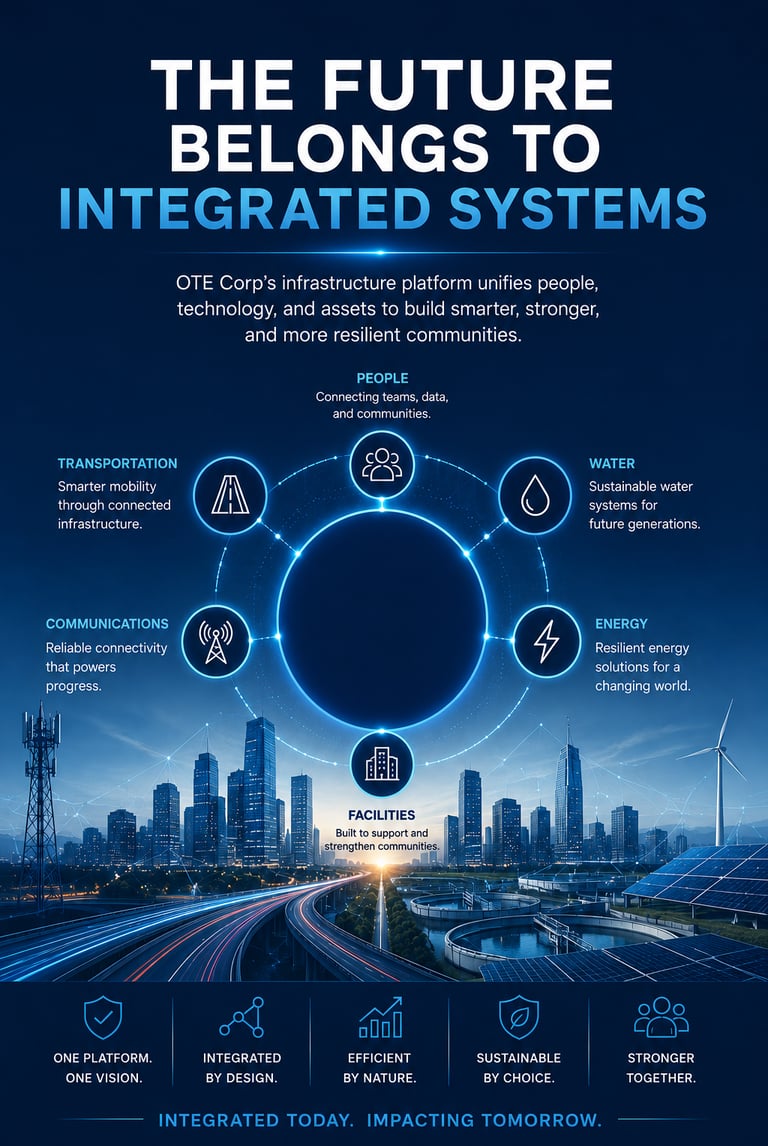
The Future Belongs to Integrated Systems

The next era of infrastructure will not be defined by isolated projects.

It will be defined by integrated ecosystems.

Microgrids connected to resilient water systems.
Advanced manufacturing paired with workforce housing.
Data infrastructure aligned with energy generation.
Regional planning built around long-term resource sustainability.

The organizations that lead this transition will think systemically rather than sector-by-sector.

They will recognize that resilience is not created through a single asset. It emerges from the coordination of interconnected systems operating together.

This requires a new strategic framework:

  • Infrastructure as national resilience

  • Energy as economic security

  • Water as strategic capacity

  • Housing as critical enablement

  • Regional planning as long-term stabilization

The challenge is not simply building more infrastructure.

The challenge is building infrastructure that enables societies to endure, adapt, and grow under changing conditions.

black blue and yellow textile

I had an excellent experience! The service was outstanding.

Happy client

a very tall building with lots of windows

A New Infrastructure Era

We are entering a period where resilience will become one of the primary drivers of investment, policy, and economic competitiveness.

The companies that understand this shift early will help shape the next generation of infrastructure development.

Not through short-term thinking.

But through integrated, durable systems designed for long-term continuity.

Because resilience is no longer a defensive strategy.

It is the architecture of future growth.

128 E. Grant Street
Suite 103
Lancaster, PA 17602
United States of America

info@jpfvg.com
+1 717 715 0238

Disclaimer: This site is informational and does not constitute an offer to sell securities.

Copyright © 2026 JPF Venture Group, Inc.

Strengthening Communities Through Resilient Infrastructure.